

The newest GLP-1 drugs are extraordinarily good at taking weight off, but they can’t choose what kind of weight goes. On DXA scans, somewhere between a quarter and 40% of the loss is lean mass rather than fat. Although that’s roughly the same ratio you get from dieting, the sheer number of people on GLP-1s has made the problem far more common.
For most people, losing some muscle alongside fat is an annoyance. For an older adult, or for anyone already close to the line on strength, you can arrive at a healthy weight and still not be able to carry your own groceries. More than a dozen companies are now racing to protect muscle while the weight comes off. Almost none of them will ever have to show it made a difference.
Lean Mass Isn’t Muscle (and Muscle Doesn’t Guarantee Function)
Most obesity trials measure body composition with DXA, which is practical but blunt. It divides the body into fat, bone, and “lean mass,” and lean mass is not just muscle. It includes organs, water, connective tissue, and the glycogen stored in muscle and liver. So a drop in DXA lean mass might mean you’re carrying less water, not that your skeletal muscle is shrinking.
Even if we use more precise tools like MRI to measure actual muscle size, bigger muscles aren’t automatically better muscles. What matters runs up a four-rung ladder, from the easiest measurement to the most meaningful one:
Body composition (DXA): Everything that isn’t fat or bone, lumped together.
Muscle volume (MRI or CT): Actual anatomical muscle size, and whether fat is infiltrating it.
Strength: Can you generate force? Grip, leg press, and the like.
Everyday function: Can you climb the stairs, get out of a chair, carry the groceries?
A drug can make a DXA scan look better without making it any easier to climb the stairs.
Three Ways to Change the Mix
Developers are working three angles, one of which is not really a single coherent category so much as a grab-bag of mechanisms based on drugs borrowed from another field.
Approach 1: Release the Brakes on Muscle
Our bodies have built-in brakes on muscle growth, primarily controlled by signaling proteins called myostatin and activins. If you block these signals, you take the brakes off.
Take the brakes off, broadly: Bimagrumab blocks the shared receptors, ActRIIA and ActRIIB, that both myostatin and the activins use. Those receptors have other work to do, so the approach is blunt as well as effective, and the side effects come with the breadth.
Take the brakes off, selectively: Apitegromab binds myostatin before it becomes active and leaves the activins alone. Regeneron is testing the other way round, pairing trevogrumab against myostatin with garetosmab against activin A to cover both at once.
Approach 2: Steer the Loss Toward Fat
The liver keeps track of how much fat is circulating in the blood. When there’s too much, it releases a hormone called activin E, made from a gene called INHBE, and activin E tells fat cells to hold on to what they’ve already stored. People born with a broken copy of INHBE carry less of their fat around the middle. Nature ran the experiment first.
Two sets of programs are trying to copy it with RNA interference: switching off the liver’s signal (INHBE) or disabling the receiver on the fat cell (ALK7). Either way, the aim is to make visceral fat the first thing the body reaches for. If muscle is preserved here, it’s simply because fat took the hit instead.
Approach 3: Work on the Muscle Directly
A third group does not touch the muscle-growth brakes or the fat-storage signal at all. These drugs act on muscle by other routes: Veru’s enobosarm through androgen receptors, Biophytis’s BIO101 through the MAS receptor, Actimed’s ACM-001.1 through adrenergic signaling. None of the three companies came from obesity. All were working on sarcopenia and cancer cachexia, where patients are wasting rather than dieting, and where a drug has long been expected to prove it does something the patient can feel.
What the Evidence Shows
Bimagrumab and apitegromab have taken this furthest. In a 72-week trial, bimagrumab increased lean mass while dropping fat, on its own and alongside semaglutide. Apitegromab, added to tirzepatide for 24 weeks, preserved about 55% of the lean mass that would otherwise have been lost.
I examined the trial records to match them up against where they fall on the ladder. I also looked for related publications to classify each program’s strength of evidence.
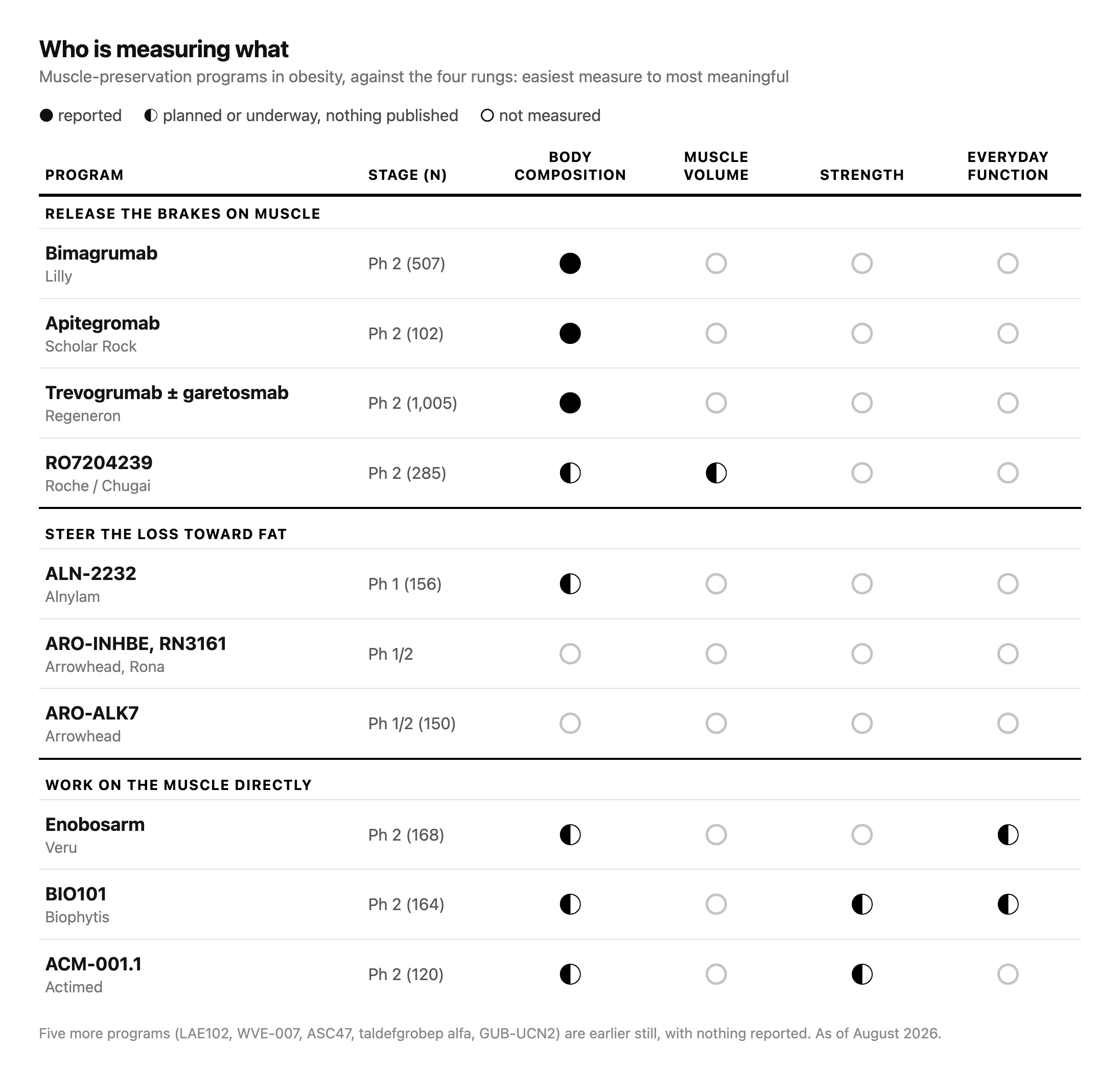
None of these programs has yet published a strength or a functional result, and only one, Roche’s RO7204239, another program aimed at the muscle-growth brakes, is imaging muscle directly at all. Notice where the few marks under Strength and Everyday function do fall. Every one of them belongs to the drugs that came over from sarcopenia and cachexia. The obesity field has not adopted their standard of proof. It has borrowed companies that arrived carrying it.
When I first started researching this field, I thought the main reason for lack of strength or functional outcomes was just a matter of trials being in earlier phases. I was surprised to learn that muscle-preservation drugs can be categorized as weight-loss drugs, making measures like everyday function optional. The FDA’s current draft guidance for weight-loss drugs, issued in January 2025 to replace a version written in 2007, makes percentage change in body weight the primary endpoint. Body composition is something it suggests measuring in a sample of patients. Physical function sits among the optional secondary assessments. When the agency met Veru at the end of Phase 2 that September, it applied the same logic, asking for incremental weight loss on top of the GLP-1, not evidence that anyone was stronger. The quality of the weight loss is what every one of these programs is selling, and it is not what any of them has to demonstrate.
The agency has not identified an adverse clinical impact from losing lean mass. Neither have others, though the looking has been thin: a study published this year that measured strength directly ran ten adults with type 2 diabetes on semaglutide and found knee-extension and grip held up. Its authors open by noting that muscle mass and function are not routinely assessed in obesity studies, and that original data on the matter remains sparse. Nothing has been found partly because so little has been looked for.
The Unresolved Question: Will Anyone Check?
I’m waiting for the first trial to report a functional endpoint, a walking speed or a chair-stand time, and show the drug moved it. Two are scheduled to go higher than a DXA scan, though only one reaches that top rung. Actimed’s ACM-001.1 adds grip strength to a lean mass study, and Biophytis’s BIO101 makes knee extension strength its primary endpoint and adds walking and stair-climb tests, because both companies came from fields where you cannot get a drug approved without showing that. Neither is running these tests on obesity medicine’s behalf. Veru’s enobosarm trial administers a stair climb as well, though it has not registered it as an outcome measure, so it may never be reported. Both scheduled readouts are due in 2027, if they run to plan.
Until one of them arrives, you have the ladder. When the next release tells you a drug preserved lean mass, that is the bottom rung: a DXA number, which is not muscle, which is not strength, which is not the same as carrying the groceries. Nobody has to close that distance. The only intervention with evidence at the far end of the ladder remains the oldest one: resistance training, with enough dietary protein to support it.
A better DXA scan cannot replicate what resistance training does. Lifting weights trains the nervous system, improves balance, and strengthens bone. If you take these drugs, you should also be training. The drug keeps the tissue, and you teach your body how to use it.
Keep up with the weekly changes
GLP-1 Weekly Updates brings together the latest trial changes, results, regulatory events, and industry news each week.
This newsletter compiles publicly available information from press releases, news sources, peer-reviewed publications, and trial registries. Not investment advice.
Get in touch: Reply to this email, leave a comment on the post, or find me on X @GLP1observer. Explore the GLP-1 dashboard at glp1.bio1up.com, browse the GLP-1 Field Guides for explainers on each mechanism class, or see the GLP-1 Verdict, the obesity-drug scoreboard.