This week, we had two major FDA submissions within days of each other. Novo Nordisk filed CagriSema for weight management, and Lilly submitted orforglipron. For the latter, positive ATTAIN-MAINTAIN data showed the oral GLP-1 can help patients maintain weight loss when switching from injectables. That seems to me like a pretty big deal, given that a significant fraction (figures vary but as high as 50%) of those taking GLP-1s stop them within a year and often regain much of the weight they lost (pubmed). Add in Altimmune’s pemvidutide advancing toward Phase 3 for MASH and it was a busy week for the pipeline.
For the Trial Spotlight, I chose Lilly’s eloralintide ENLIGHTEN-2 study -- a selective amylin agonist that represents Lilly’s bet on a GLP-1-sparing approach. The Mechanism Explained section covers the scientific rationale of combining amylin with GIP activation, a pairing that could offer an alternative for patients. The reality is that people respond differently to different weight loss drugs and so having alternatives that are potentially better tolerated may be important.
Thanks for reading GLP-1 Observer! Subscribe for free to receive new posts and support my work.
🔥 THIS WEEK’S KEY DEVELOPMENTS
Novo Nordisk submits CagriSema to FDA for weight management approval.
Novo Nordisk has submitted a New Drug Application (NDA) to the U.S. FDA for once-weekly CagriSema (cagrilintide 2.4 mg and semaglutide 2.4 mg) for long-term weight management in adults with obesity or overweight. The submission is based on the REDEFINE clinical program, including the REDEFINE 1 phase 3 trial, where CagriSema demonstrated an average body weight loss of 23%. The FDA is expected to review the application in 2026.
Lilly submits oral weight loss drug orforglipron to FDA.
In the Phase 3 ATTAIN-MAINTAIN trial, Lilly’s once-daily oral orforglipron met its primary and all key secondary endpoints for weight maintenance versus placebo at 52 weeks. The study evaluated participants who switched to orforglipron after achieving weight loss on injectable Wegovy or Zepbound. At 52 weeks, participants switching from Wegovy maintained all but 0.9 kg of their previously achieved weight loss on average, while those switching from Zepbound had an average difference of 5.0 kg. Lilly has submitted orforglipron to the U.S. FDA for the treatment of obesity.
Positive MASH data advances Altimmune’s pemvidutide to Phase 3.
Altimmune announced positive 48-week topline results from its IMPACT Phase 2b trial of pemvidutide in patients with MASH. The 1.8 mg dose achieved a mean reduction in Liver Stiffness Measurement (LSM) of -3.97 (p<0.001) and a mean weight loss of 7.5% (p<0.0001), compared to -0.03 and 0.2% for placebo, respectively. The discontinuation rate due to adverse events was 1.2% for the 1.8 mg dose versus 3.5% for placebo, and the company plans to initiate a Phase 3 program in 2026.
GZR18 Injection Phase 3 extension study evaluating long-term safety and efficacy for weight loss in participants from a prior trial (Gan & Lee Pharmaceuticals, n=500)
Tirzepatide Phase 2 trial investigating the drug plus cognitive-behavioural therapy (CBT) for Alcohol Use Disorder in adults with obesity (South West Sydney Local Health District, n=46)
GALACTUS Trial Phase 3 investigating the effect of GLP-1 and SGLT2 inhibitors on inflammation following myocardial infarction (Instituto Mexicano del Seguro Social, n=44)
[New Indications]
Trials: NCT07295223 (GALACTUS) | Mechanism: GLP-1 RA as comparison
Semaglutide and Tirzepatide trial investigating their effect on genetic aging delay in adults with obesity (Second Affiliated Hospital, Zhejiang University, n=66)
Semaglutide (Wegovy) Phase 2 pilot study investigating the popular GLP-1 agonist for trichotillomania, an impulse control disorder (University of Chicago, n=10)
CagriSema Phase 3 trial investigating its effect on blood sugar and body weight in children and adolescents with Type 2 Diabetes (Novo Nordisk A/S, n=80)
A Study of Eloralintide (LY3841136) in Participants With Obesity or Overweight, and Type 2 Diabetes (ENLIGHTEN-2)
This Phase 3 trial (NCT07282600), known as ENLIGHTEN-2, evaluates Eli Lilly’s eloralintide in 1,035 participants with type 2 diabetes and obesity or overweight. Eloralintide operates via a novel mechanism distinct from GLP-1 agonists; it is a selective amylin receptor agonist (preferentially targeting AMY1R) designed to induce satiety and weight loss while potentially minimizing the gastrointestinal side effects associated with non-selective amylin analogs. The ~75-week, randomized, placebo-controlled study will assess the drug’s efficacy in weight reduction, a crucial endpoint given that weight loss is often harder to achieve in patients with type 2 diabetes compared to those without. Strategically, this trial positions Lilly to compete directly with other emerging amylin-based therapies (such as Novo Nordisk’s cagrilintide) and diversifies the company’s obesity portfolio beyond incretin-based treatments like Zepbound (tirzepatide), offering a potential alternative for patients who may not tolerate or respond adequately to GLP-1 therapies.
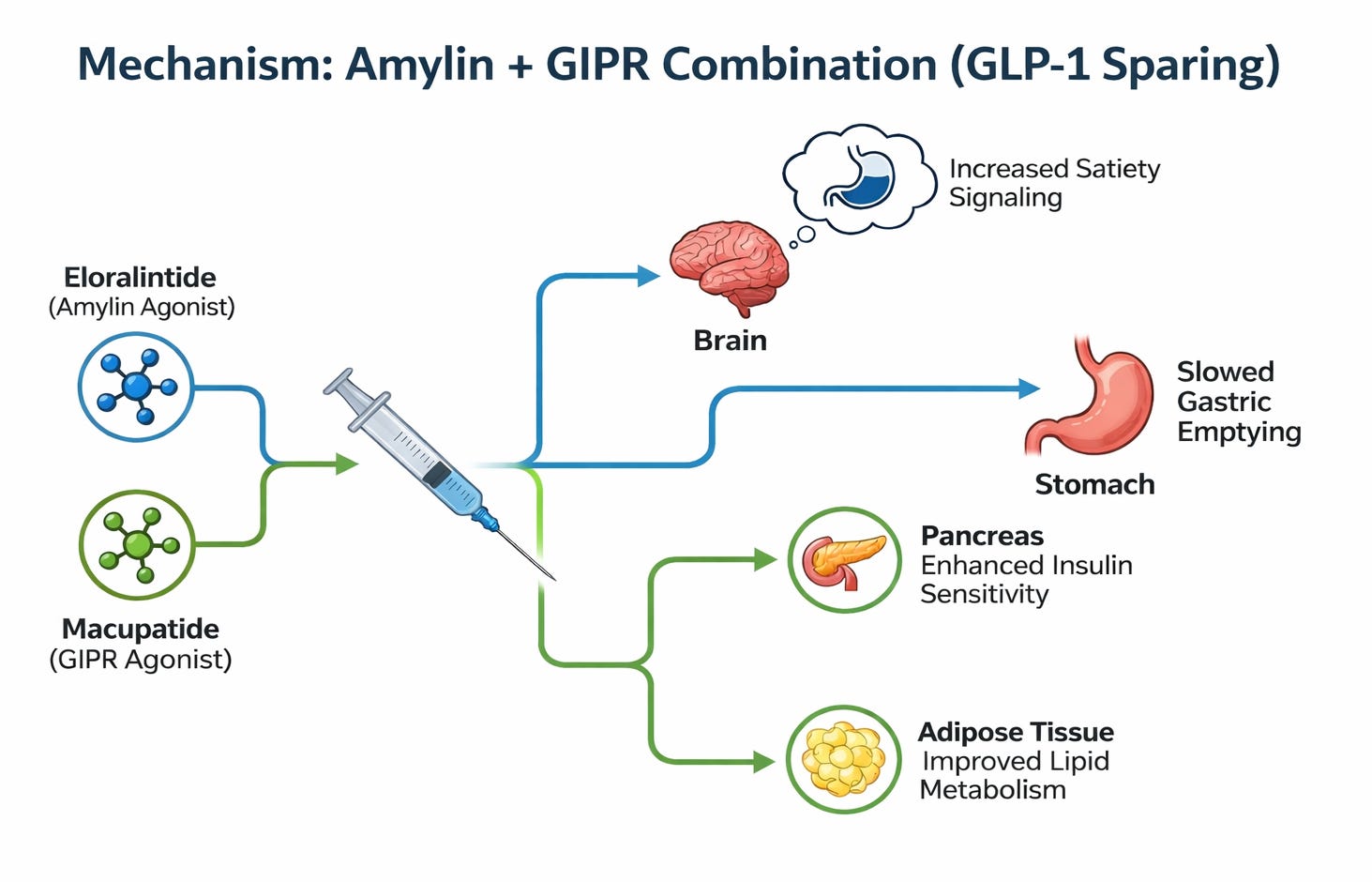
This therapeutic approach represents a strategic evolution in the obesity landscape by testing a “GLP-1-sparing” combination of eloralintide, a selective amylin receptor agonist, and macupatide, a selective GIP receptor agonist. Eloralintide mimics the hormone amylin (normally co-secreted with insulin) to centrally signal satiety and physically slow gastric emptying, targeting the same pathway as the “Cagri” component of Novo Nordisk’s CagriSema. Macupatide complements this by isolating the GIP pathway—the key metabolic differentiator of Lilly’s own tirzepatide—to enhance insulin sensitivity and lipid metabolism without direct GLP-1 receptor activation. By decoupling these mechanisms from the standard GLP-1 backbone, this fixed-dose combination aims to determine if targeting neuroendocrine satiety (Amylin) and metabolic efficiency (GIP) together can drive profound weight loss with a potentially differentiated tolerability profile.
This newsletter compiles publicly available information from company press releases and ClinicalTrials.gov. Not investment advice.
Thanks for reading GLP-1 Observer! Subscribe for free to receive new posts and support my work.