This week is a study in contrasts. Novo Nordisk delivered both a disappointment and a breakthrough. On the challenging side, oral semaglutide failed to slow disease progression in Phase 3 Alzheimer’s trials -- a reminder that while these mechanisms are transformative for metabolic disease, they won’t be a cure-all for every condition.
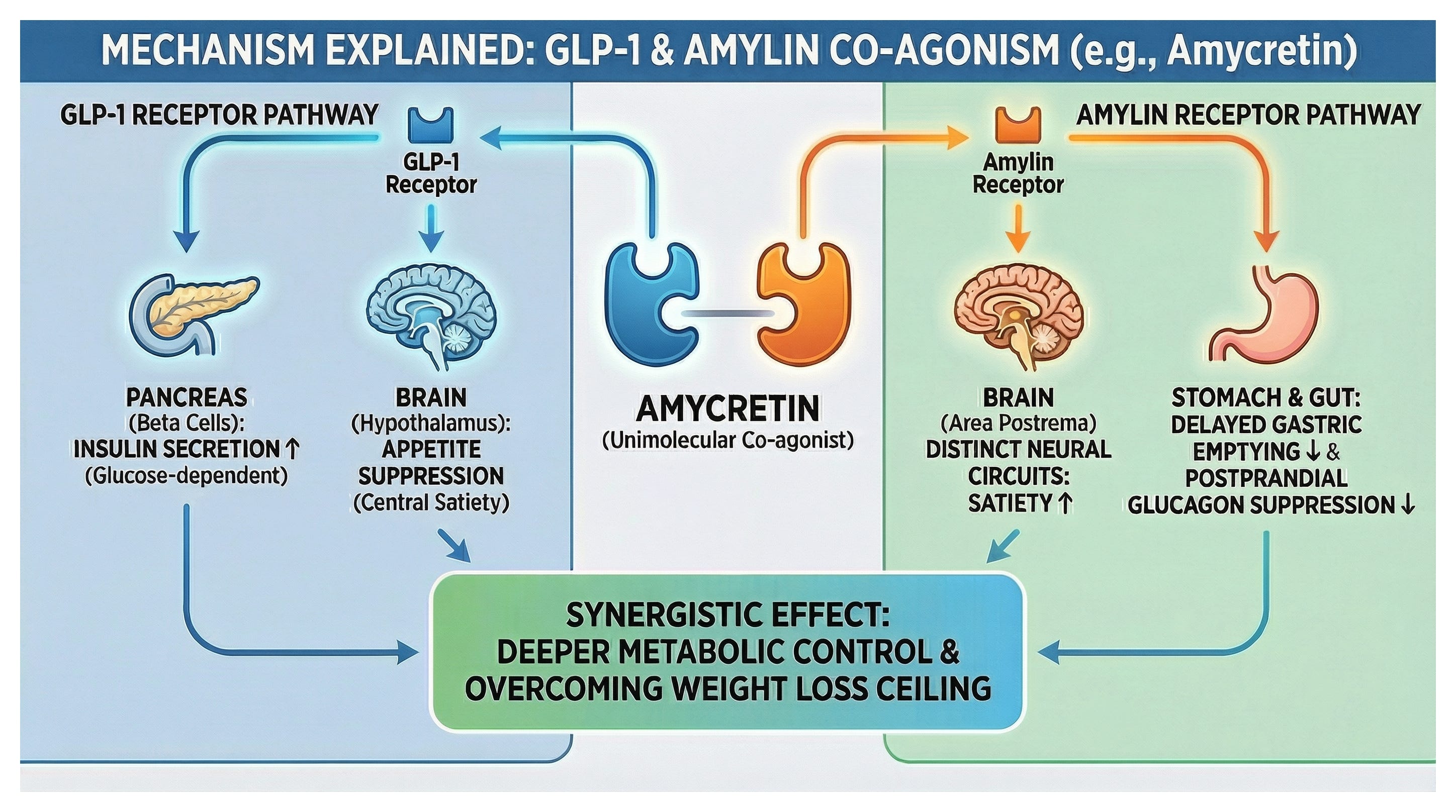
But on the weight-loss frontier, things are moving fast. Novo filed for a higher 7.2 mg dose of Wegovy and released strong Phase 2 data for amycretin, a GLP-1/amylin co-agonist that achieved up to 22% weight loss at 36 weeks. This could represent the next efficacy ceiling to beat. I’ve dedicated the Mechanism Explained section to amycretin to break down how targeting amylin alongside GLP-1 aims to push past the plateaus seen with current therapies.
Thanks for reading GLP-1 Observer! Subscribe for free to receive new posts and support my work.
Novo Nordisk announced that the phase 3 EVOKE and EVOKE Plus trials of oral semaglutide in 3,808 adults with early-stage Alzheimer’s disease did not meet their primary endpoint. The trials failed to demonstrate a statistically significant reduction in disease progression as measured by the change in Clinical Dementia Rating – Sum of Boxes (CDR-SB) score compared to placebo. Although treatment improved Alzheimer’s-related biomarkers, this did not translate into a delay of disease progression, and the 1-year trial extension will be discontinued.
Novo Nordisk seeks FDA approval for higher-dose Wegovy.
Novo Nordisk has submitted a supplemental New Drug Application (sNDA) to the U.S. FDA for a higher 7.2 mg dose of Wegovy® (semaglutide) for chronic weight management in adults with obesity. The submission is based on the phase 3 STEP UP trial, where adults treated with the 7.2 mg dose achieved an average weight loss of 20.7% after 72 weeks, compared to 17.5% with the 2.4 mg dose and 2.4% with placebo. The sNDA will be reviewed under the FDA’s accelerated Commissioner’s National Priority voucher (CNPV) pilot program.
Positive Phase 2 results for amycretin in type 2 diabetes.
Novo Nordisk announced positive headline results from a phase 2 trial of amycretin in people with type 2 diabetes. At 36 weeks, once-weekly subcutaneous amycretin demonstrated a statistically significant weight loss of up to 14.5% and reduced HbA1c by up to -1.8%. The company stated that amycretin appeared to have a safe and well-tolerated profile and that it plans to initiate a phase 3 development program in 2026.
Press | Mechanism: GLP-1 and amylin receptor co-agonist
🆕 NEWLY REGISTERED TRIALS (7 in last week)
IBI362 Phase 3 trial for the treatment of obesity or overweight in Chinese adolescents (Innovent Biologics, n=180)
GLP-1 Receptor Agonists Phase IV investigating their effect on psoriatic arthritis in patients without diabetes (Chinese University of Hong Kong, n=40)
Phase 4 trial comparing the effects of selected antidiabetic drugs on atherosclerosis in patients with coronary artery disease and pre-diabetes (National Institute of Cardiology, Warsaw, n=300).
Phase IV trial of a metformin + SGLT-2i + GLP-1RA triple therapy for patients with poorly controlled type 2 diabetes (Hangzhou Zhongmei Huadong Pharmaceutical, n=430)
A Study of Tirzepatide (LY3298176) Compared With Standard of Care in Adult Participants With Obesity and Without Diabetes (SURMOUNT-REAL UK)
Eli Lilly’s SURMOUNT-REAL UK study is a large-scale, Phase 4 trial designed to evaluate the real-world effectiveness of tirzepatide for obesity in 3,000 adults without diabetes. This open-label study will compare tirzepatide against the standard of care, which consists of lifestyle interventions like diet and physical activity, over a five-year period expected to begin in late 2025. Tirzepatide functions as a dual-agonist, activating both GLP-1 and GIP receptors to regulate appetite and energy balance. The strategic significance of this trial lies in its real-world setting, which aims to generate long-term data on not only weight loss and prevention of related diseases but also on healthcare resource use and quality of life. This evidence is crucial for informing future clinical guidelines and healthcare policy for obesity treatment within the UK.
GLP-1 and Amylin Co-agonism (Example drug: Amycretin (NNC0487-0111), subcutaneous and oral)
NNC0487-0111, also known as amycretin, is a unimolecular co-agonist that simultaneously activates both the GLP-1 receptor and the amylin receptor, distinguishing it from current therapies that target GLP-1 alone or in combination with GIP. While the GLP-1 component drives familiar mechanisms of insulin secretion and central satiety, the amylin moiety engages distinct neural circuits—specifically in the area postrema—to further delay gastric emptying and suppress postprandial glucagon. This dual-pronged approach is critical because it targets complementary physiological pathways to overcome the weight-loss “ceiling” often seen with mono-agonists, theoretically offering additive or synergistic efficacy. Early clinical data supports this hypothesis, showing weight loss figures that may significantly outperform semaglutide, positioning amycretin as a potent “next-generation” asset designed to rival emerging triple-agonists and oral competitors. By validating the co-agonism of amylin and GLP-1, this therapeutic represents a shift toward mimicking a broader spectrum of endogenous satiety signals to achieve deeper metabolic control.
This newsletter compiles publicly available information from company press releases and ClinicalTrials.gov. Not investment advice.
Thanks for reading GLP-1 Observer! Subscribe for free to receive new posts and support my work.